Two Stories
Umbrella
When she saw the boy for the second time she knew that she could love him. His face was big and his shoulders were big and he looked lost. He was holding an umbrella.
“It was supposed to rain,” he said, and together they turned and looked out the window where the sky was blue and it was sunny and there were no clouds in the sky.
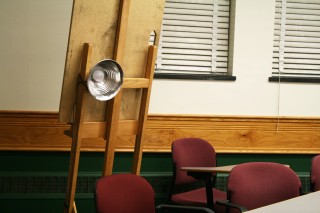
They had been recruited to stand as models for a man who was a successful academic and also a painter. Neither the boy nor the girl understood what made a successful painter and they were both a little disappointed when they saw the academic’s paintings. After the first session, they walked together in the hallway outside the studio and talked about the academic and about his paintings and about other things as well.
Inside the studio, they changed into the outfits prepared for them. The girl was given a sheet, which she draped over one shoulder and knotted. The boy wore a piece of fabric tied around his waist. They could not help noticing one another dressed like this. The girl noticed the boy’s stomach. There was a little fat on his stomach, but it was nice. She noticed a mark beneath his belly button where it looked like someone had once pressed a finger.
They stood together on the wooden platform and assumed positions. The academic lifted the girl’s arm, holding her by her wrist, placing her hand on the boy’s big shoulder. He turned her hips so that her body was turned toward the boy. He was quiet as he positioned them and they were quiet and docile. The platform they stood on was a piece of wood on the concrete floor; the academic called it a platform.
What the girl loved about the boy could be found in his stomach. His dumbness. There was dumbness in his big face and dumbness in his stomach and she knew immediately that this was the sort of thing that could make her endlessly happy. The room smelled like turpentine. Working at his canvas, the academic whistled an aria.
Standing beside him on the platform, her hand on the boy’s shoulder and her eyes straight ahead, the girl heard, behind her, the sound of the rain. She heard it lightly at first, tapping against the window, and then the rain fell heavily.
Mark Rothko (February, 1935)
The painter sat at the square table near the window. His knees pressed against the table because the table was designed for children with children’s knees and not the folded legs of a thirty-two year old man. There was thin vegetable soup in a paper bowl and an apple and a cookie and a cardboard carton of chocolate milk on a pink plastic tray on the table. The children’s artwork hung on the walls of the room: drawings of dogs with scribbled spirals of hair, paintings of boats with flat hulls, tall buildings, a painting of mittens. Why mittens, he had asked the girl as she leaned over her paper, pushing her tongue between her teeth. Because it’s cold in winter, she said to him.
He looked at the easel across the room where his own work hung half-finished. The painting was not real work, but a demonstration of real work for the children’s sake. The soup was no longer warm and the carrots in the soup were soft, breaking apart in his cheeks. He ate in the room where the children painted to avoid eating in the room with the other instructors, the room where Rabbi Levinthal sometimes paced, nodding appreciatively, resting his hands against his belly as he walked.
The room beneath the children’s room was the pool room, and while he ate he could hear the faint sound of the water and the splashing of bodies in the water, the echoing voices of the men who visited in the afternoons, members of a new Jewish middle class who came and swam laps before retiring to the center’s health club or lounge. Bringing a spoonful of the soup to his mouth, some spilled and fell onto his pant leg. When, earlier that day, he passed Rabbi Levinthal’s office, the door was open and he looked inside. The rabbi was standing beside his desk, running his finger along the spines of the books on his shelves. He was standing on the tips of his shoes and reaching with his finger to feel the books on the shelves above his head.
It was 1935. The painter had been teaching art to the children at the center twice a week for six years. In 1934, he published his essay, “New Training for Future Artists and Art Lovers,” in The Yale Pest in association with an exhibition of his student’s artwork he organized at the Brooklyn Museum. In the essay, he told the story of a boy who, not knowing what to draw, was assisted by a girl who had recently seen and been impressed by a cotton gin. She described the machine to the boy, one detail at a time, so that he painted a picture of what was, to him, a purely imaginary object.
The painter ate in the children’s art room when his lesson was finished, after the children were gone. He ate in the room to avoid going home and eating beside Edith, to avoid hearing her talk about the jewelry endeavor and hearing her say, yet again, how he ought to join her full-time and make an honest go of it. “When I am here at work, I work,” she said to him once. The half-finished painting clipped to the easel across the room was a watercolor painting of a boy in a chair. The boy’s face hadn’t any features yet and the boy’s hands were all wrong.
He tasked the children with the care of their materials: rinsing the brushes in warm water, gently separating the bristles and letting the water run through them, shaking the brushes dry. Washing the brushes was as much a part of painting as putting paint to paper, he told them. But on days when his lessons went long and they were short on time and the children needed to be rushed to their next activities, the painter himself collected the brushes and laid them beside the sink. As he ran them under the water, he watched the paint, thinned by the water, collecting in the basin—reds less red than red, yellows less yellow than yellow—and he thought, sometimes, how advantageous it would be if he could capture these colors in the space of a painting.
There were onions in the soup, he was realizing. They’d sunk to the bottom so that now, each time he took a bite, his spoon was full of watery broth and many finely diced onions. Below his feet a man yelled something about labor relations and other men laughed. The painter pushed the tray away. The soup was gone. He’d barely touched the apple and looking at the cookie made him sick. He opened the carton of chocolate milk. He pulled the lips of the carton apart and pinched them together so that they puckered and split. Out the window, he watched three children run across the street and narrowly miss being hit by a passing bus.
____
Stephen Mortland writes fiction and lives in Utah.
Donate
This website and publication is supported by the sales of the print issues and by generous donations.Become a sponsor to support New Literature