The Burrow
Each student in my seminar on the works of Franz Kafka was asked by Jan to choose one day of class on which they might facilitate discussion of a particular text. The text I chose was “The Burrow.”
Our group had built an uneasy familiarity over the course of the term. The students seated themselves in sects determined by the extent of their knowledge of one another. These bands of two or three clustered their desks together and tended to speak for one another, as if they belonged to the same legal body and as such could offer only one interpretation apiece. At the start of the term, I had been seated beside my Polish-American roommate, but his disappearance had in effect severed me from the room; I felt my classmates’ unease at the thought of our association, though I insisted this association went no further than the sharing of this classroom and (against each of our wills) the apartment in which we slept. This rigorous denial, rather than vouchsafing my innocence, called into question the whole of my conduct, which they now regarded with utmost suspicion.
Our instructor Jan, I felt, understood me well. We glanced at one another as the others spoke, and though his expression remained changeless, I read what I wanted in it, that is approval and a measure of comradely disregard for the other students’ words.
When responding to a comment made by one of my fellow students, Jan often began, “Quite right, although…”
This elegant formulation resounded so often in our small classroom that my body had grown used to relaxing into it. Reflexively, I longed to enfold myself in whatever sentence he appended to this introductory remark.
Jan did not respond to the comments I made.
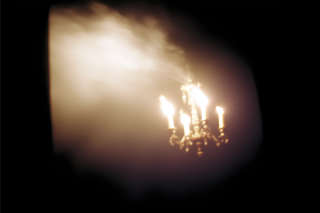
In preparation for my role as discussion leader, I revisited the Old-New synagogue in Prague’s former Jewish quarter, that I might (in secret, for all photography was outlawed therein) document the space as part of the presentation I was to give on Kafka’s text.
The interior of this squat building, lit only by candelabras set in deep alcoves along its two longest walls and hanging lamps above, fulfilled as no other synagogue I had ever entered the semantic function of the term “sanctuary.” Rather than pews, oak seats with high desks circled the walls, and each man seemed to sink deeper and deeper into the ground as the cantor strained out a meager rendition of Mi Shebeirach. Though they had been built such that each worshiper faced the center of the room and one another at all times, the arch-backed seats, separated one from another by wooden partitions, kept the men in private chambers, gazing solemnly down at their yellowed texts.
A dull, collective hum rose from the seats as the cantor sang. Rather than sharing the recitative duties of rabbi or cantor, the congregants of the Old-New synagogue conjured a groaning, earthly music all their own. It bore no resemblance to language. It was only during the recitation of the mourner’s Kaddish at the end of the service that I could discern words—Hebrew words—rising around me, and think of participating myself. Yet even now the men surrounding me marked my abuse of the Kaddish with their eyes, as if recording another in a long series of transgressions against a language neither I nor they made proper use of. I sunk down in my seat until I could not see above the rim of the desk. A pair of windows faced me, no more in truth than slits, allowing in faint streaks of daylight. Had the walls been ripped opened, exposing the cloistered scene within, I felt the congregants would at once be blinded. This hovel was their last defense against the final imposition of light.
The space I photographed was indiscernible. I scrutinized each image for identifiable details. The men had been transformed into dark smudges. The bimah was frozen in dim orange light. The alcoves along the walls opened like mouths.
I stood before my classmates. Projected behind me were the images I had taken inside the Old-New synagogue. I pointed to the vague outline of a man against one wall.
Let us say, I said, this man is the narrator of Kafka’s text. It is he who has constructed this burrow, and it is he who utters, night after night, to a ceiling which protects him from the world above and from a floor which protects him from the savage creatures of the world below, the words of Psalm 130:1: “Out of the depths, I cry to Thee, O Lord.” It is he who writes, “But the most beautiful thing about my burrow is the stillness. Of course, that is deceptive. At any moment it might be shattered and then all will be over.”
One of my classmates raised his hand. There is a difference between this man, he said, and the man in Kafka’s story. The narrator has no God, and thus he would never say the words, “Out of the depths, I cry to Thee, O Lord.”
Another spoke up. I disagree, she said, perhaps he would not use those words exactly, but the burrow is for him a holy place.
Holy, yes, the young man replied, but far from God. It is holy for him alone.
The burrow, I went on, gesturing to the entirety of the space I had photographed, is a sanctuary, perhaps the final sanctuary. Yet this sanctuary remains incomplete. It is under construction. It will never achieve its completion because it is under constant threat.
Jan spoke up: You are speaking about the Castle Keep. Yes, this is for some the heart of the text. Let us read together. You will read, yes?—he pointed to me.
Not quite in the center of the burrow, I read aloud, carefully chosen to serve as a refuge in case of extreme danger from siege if not from immediate pursuit, lies the chief cell. While all the rest of the burrow is the outcome rather of intense intellectual than of physical labor, this Castle Keep was fashioned by the most arduous labor of my whole body.
Good, said Jan. What do we think of this?
A woman whose analyses Jan often favored now spoke up. He is a paranoiac, she began. The burrow is a product of his mind. There is no such place as the burrow, and it certainly looks nothing like that. She pointed at my photographs.
No, I said, there is such thing as a burrow. And if the man is paranoid, it is only because he is actually under threat of violence, whichever way he turns.
But there is no violence, the woman replied. It is an imagined violence. Perhaps the violence happened long ago. Listen, he writes here: Invariably every now and then I start up out of profound sleep and listen, listen into the stillness which reigns here unchanged day and night, smile contentedly, and then sink with loosened limbs into still profounder sleep.
But that sleep is an illusion, I cried. His body is telling a lie, the most dangerous lie we all tell ourselves, that we are comfortable in ourselves and in the beds in which we sleep.
Let’s return to the Keep, said Jan. Kafka writes that the Keep, unlike the rest of the burrow, is the product of physical rather than intellectual labor. What do we make of this?
The young man who had claimed that the narrator had no God replied, I think it is right to say that the burrow functions like a mind. It is composed of a network of cells, each linked one to another, as our neurons are linked. And the narrator burrows deep into this mind, as deep as he can go, and to protect himself in this state he builds his Keep, let’s say his body, a body so firm and compact it can protect the vulnerable mind within.
Quite right, said Jan, although perhaps the metaphor cannot be taken so far. Of course, the Keep is within the burrow itself, not an exterior wall protecting it.
A skull, piped up the young man, protecting a brain.
Let us not confine ourselves to the literal, said Jan.
The Keep is not a skull, I said, because it is with his skull that the man constructs it. To firm up the soil required to form the hard-packed walls of the Keep, the only tool the man can use is his own forehead, which he bloodies in the process.
I wonder, said Jan, why we insist on speaking of a man.
Yes, another woman spoke up, the narrator behaves much more like an animal than a man. After all, it is small mammals who build burrows in the earth.
Once more, we need not be exact, said Jan. But yes, perhaps it is right to say the narrator’s behavior is more animal than human. His fixation on predation, for example, suggests that it is the whole of his species under threat from the outside world.
He is a member of a species apart, I said, but a species of man nonetheless.
We should resist, Jan replied, raising his voice slightly, any interpretation which tends toward the allegorization of a biographical detail. Why don’t you switch the screen off now, I believe we’ve seen enough. The subject at hand is the text, not a lesson in architecture, though the building is fascinating and I recommend you all go see it while you are in Prague. Now, go on, please. Have you any other questions?
If the man—if the narrator—is so paranoid, I began, why is it that he leaves the burrow?
For food, someone replied.
The young woman who had described the burrow as the narrator’s holy place spoke up: We cannot take the narrator at his word. What he says is, in all likelihood, full of lies and misdirections. No one can live all his life underground, and yes, he comes up to hunt for food. But he is also selfish and covetous. He leaves his burrow, so he writes, just to protect it. But if it is secrecy he wants, he would stay in his burrow at all times, only exiting under cover of night and reentering as quickly as possible. Instead, he sits outside the entrance to his beloved home and waits, to protect the entrance from no one and nothing at all, imagining all that time the filthy creature in the distance approaching his burrow, who plans to make a mockery of it. He even goes so far as to say that the creature may be someone like himself, a connoisseur and prizer of burrows, whose only sin is that he has sought refuge in a land already laid claim to. So you see, the narrator is only a selfish landowner seeking to protect himself from the outsiders he so hates.
There is only one true burrow, I said. That is why he is so protective. He knows he is the maker of the real burrow, the only burrow that counts. But the connection is much deeper than that. He writes, I and the burrow belong so indissolubly together—
Yes, Jan intervened, why is it that the narrator and the burrow belong, as you say, indissolubly together?
A certain young man whose interpretations often skewed toward reflexivity replied, it is his text. He is the burrow’s author, and there can be no other. Likewise, Kafka…
Quite right, said Jan, although this account is also a little narrow. The burrow does not behave much like a text, does it?
But the narrator, animal or man, he writes, the young man pushed back. His means of writing are “paws” and “claws,” but nonetheless he writes.
Very well, said Jan.
Let us talk about the beast, I said.
Yes, said Jan, this is quite essential. Let us talk about what you call the beast. Is there such thing as a beast in the story? Let us have a show of hands. Is there a beast?
None of my classmates raised their hands.
Is there no beast at all?
A few reluctant hands.
Well, said Jan, which is it? What do you think, he asked me.
Yes, I said, there is a beast. But it will never enter the burrow, not so long as the narrator lives. The narrator’s life is the guarantor of the burrow’s security. All the same, he will be tortured by the noise, and by the suspicion that the very next day the beast will break through, and rupture the stillness of the burrow once and for all. So it is like this, everything remains unchanged, the man—the narrator—lives inside the burrow and grows more and more suspicious, perhaps suspicion will be his final condition. Yet he will die safe.
That is no life worth living, said one of my classmates.
There is no beast, said another, not really.
A third said, Beasts belong to the imagination, as do burrows.
It is a fiction, said a fourth. There is no beast.
But the sound, I replied. He hears the sound.
Outside, a slow rain fell.
____
Adam Judah Krasnoff lives in New York. “The Burrow” is an excerpt from his novel, Field, forthcoming from Staircase Books in 2026.
Donate
This website and publication is supported by the sales of the print issues and by generous donations.Become a sponsor to support New Literature