Poems from Procne Machine (I)
Translated by Will Schutt.
_____
I’ve always been afraid of you.
Of your shadow cast on a wall,
your feathers on staircases, the dull beat
of your wings against your bodies, stuffed
with organs and entrails, like humans.
The constant threat of being
struck on the street, of being grazed.
Muscles tense, pupils dilated.
Mind gripped by a single thought.
How can we shield ourselves from what
threatens or claims us from above.
Ho sempre avuto paura di voi.
L’ombra del volo sulle facciate,
le piume nelle scale, il battere sordo
delle ali intorno al corpo pieno
di organi e viscere come umani.
La minaccia costante nelle strade
di essere colpiti, di essere sfiorati.
I muscoli in allerta, le pupille dilatate.
La testa inchiodata a un solo pensiero.
Com’è possibile difendersi da ciò
che ci minaccia o ci reclama dall’alto.
――
Where I live there survive many species
and many songs. They build their nests
on top of churches, next to landfills,
near sewers that empty into the sea.
I observe them from my window, in the rare
bits of greenspace between the buildings. I look for them, I wait.
They’re sparrows or blackbirds. Hidden in the pines.
But at night it’s seagulls that sweep through the square,
removed from the racket. I follow them, I watch
as they drop from the sky, I see them
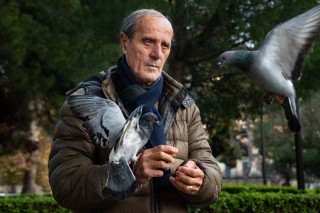
attack pigeons, striking them in the chest, the neck
till they come crashing down on rooftops or terraces.
In the morning, parked cars are covered with wings and cartilage.
It is, it seems, nature’s way, self-interest of the species,
yet sometimes there’s something more to it, or less,
something having to do with boredom.
Qui dove vivo resistono molte specie,
e molti canti. Costruiscono nidi
sui tetti delle chiese, accanto alle discariche,
vicino agli scoli delle fogne in mare.
Da qualche tempo li osservo alla finestra
nei pochi spazi verdi tra i palazzi. Li cerco, li aspetto.
Sono passeri o merli. Se ne stanno nascosti tra i pini.
Di notte, invece, i gabbiani volano sulla piazza
alti fra grandi strepiti. Li seguo, li accompagno
mentre scendono in picchiata, li vedo
attaccare i piccioni, colpirli al petto, al collo,
e loro inermi si schiantano sopra tetti o terrazzi.
All’alba restano ali e cartilagini sulle auto parcheggiate.
Legge di natura, interessi della specie, pare,
ma a volte c’è qualcosa di più, o di meno,
qualcosa che ha a che fare con la noia.
____
Carmen Gallo’s first three collections of poetry, Paura degli occhi (2014), Appartamenti o stanze (2017) and Le fuggitive (2020, winner of the Premio Napoli), were recently collected in Stanze per una fuga (2025). She has published translations of Eliot’s The Waste Land, Shakespeare’s Romeo and Juliet and Hannah Sullivan’s Three Poems. Originally from Naples, she teaches English literature at La Sapienza Università di Roma. Her most recent book of poetry, Procne Machine, is a finalist for the 2026 Strega Prize.
Will Schutt’s work has been recognized with numerous awards, including the Yale Younger Poets Prize, the Amy Lowell Travelling Poetry Fellowship, and the Raiziss/de Palchi Translation Award from the Academy of American Poets. He is the author of Westerly (Yale University Press 2013) and translator of several works from Italian, including Brief Homage to Pluto and Other Poems by Fabio Pusterla (Princeton University Press 2023) and My Life, I Lapped It Up: Selected Poems of Edoardo Sanguineti (Oberlin College Press 2018). He lives in Rome, where he teaches at John Cabot University, and co-curates Policromia, an annual international festival of poetry and translation in Siena.
Donate
This website and publication is supported by the sales of the print issues and by generous donations.Become a sponsor to support New Literature